
What Is RevOps?
The Complete Guide for SMBs and Startups
Reading Time: 12 min

Revenue teams are under more pressure than ever. Sales misses quota. Marketing generates leads that never convert. Customer success watches churn tick upward. Each team blames the other and leadership wonders why the revenue number keeps slipping.
The problem isn't effort. It's architecture. When your Sales, Marketing, and Customer Success teams operate in separate silos with different tools, different data, and different definitions of success; revenue leaks at every handoff.
Key Insight
Companies with fully aligned revenue teams grow 19% faster and are 15% more profitable than their peers. (Forrester Research)
Enter Revenue Operations, or RevOps. In this guide, we'll explain exactly what RevOps is, why it matters, and how to build it from scratch.
What Is RevOps? A Clear Definition
Definition
Revenue Operations (RevOps) is a business function that unifies Sales, Marketing, and Customer Success under a single, shared operational model. With aligned processes, shared data, and a unified technology stack — to drive predictable, scalable revenue growth.
One Sentence Definition
RevOps is the operational layer that removes silos between revenue-generating teams so that every person, process, and tool works toward the same number.
Where RevOps Came From
RevOps emerged around 2018 as B2B SaaS companies scaled their go-to-market (GTM) motions. As subscription revenue models replaced one-time transactions, it became clear that the old siloed model: separate Ops teams for Sales, Marketing, and CS creating too many blind spots. The term was popularized by Salesforce and quickly adopted by high-growth technology companies.
How RevOps Works in Practice
Rather than having three separate Ops functions reporting to three different leaders, RevOps consolidates them under one team often led by a VP of Revenue Operations or Chief Revenue Officer. That team owns:
The CRM and all revenue technology
Data governance and reporting standards
GTM process design and documentation
Forecasting and pipeline management
Revenue analytics and performance insights
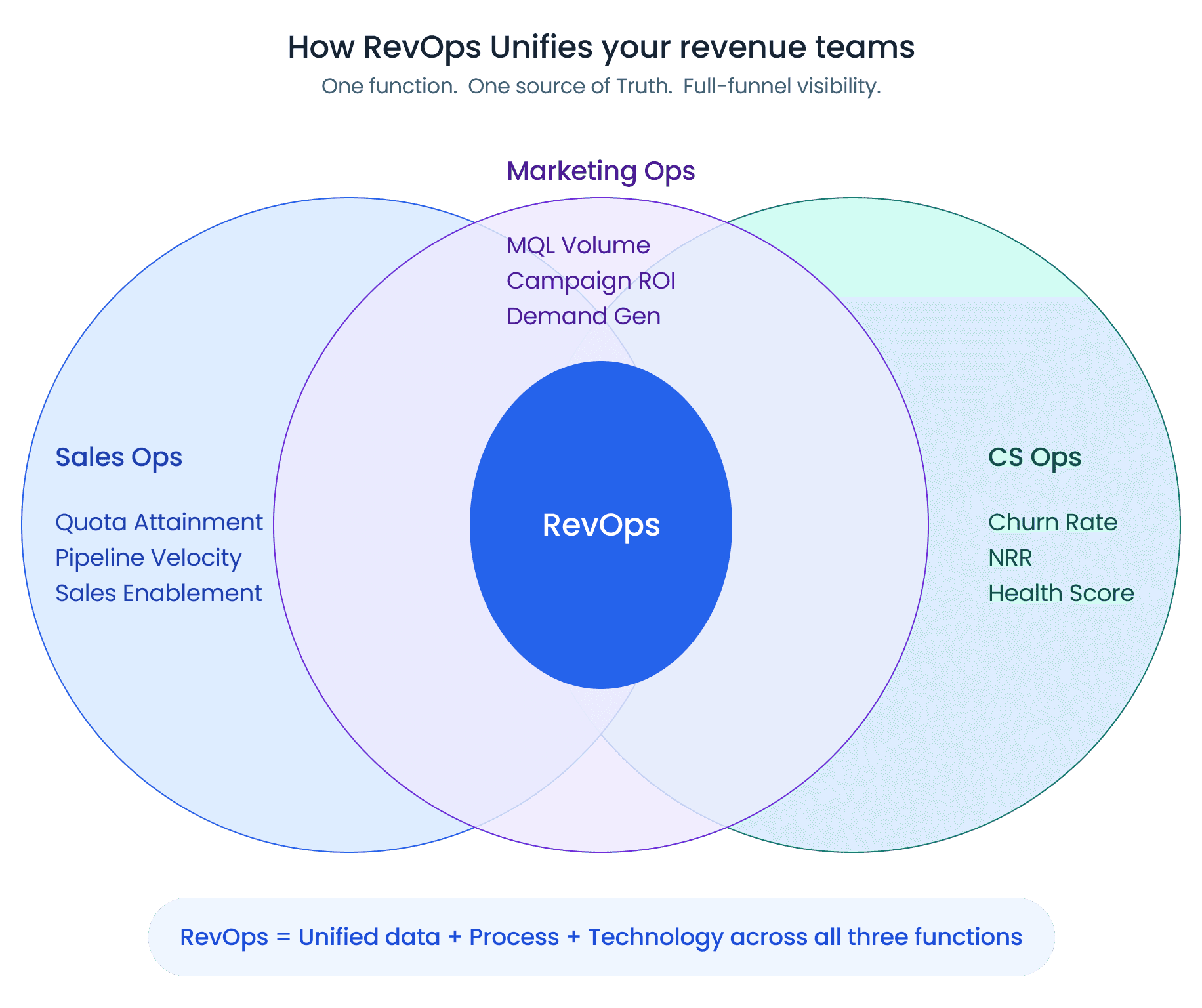
RevOps vs. Sales Ops vs. Marketing Ops
One of the most common points of confusion is how RevOps relates to — or replaces — traditional Sales Operations and Marketing Operations. Here's a direct comparison:
Aspect | RevOps | Sales Ops | Marketing Ops |
|---|---|---|---|
Scope | Full customer lifecycle | Sales pipeline only | Top-of-funnel only |
Owner | VP RevOps / CRO | VP Sales | CMO |
Focus | End-to-end revenue | Quota attainment | Lead generation |
Key Metric | NRR, Pipeline Velocity | Win Rate, ARR | MQL Volume, CAC |
Data Access | All teams (unified) | CRM only | MAP only |
Important Note
RevOps doesn't replace Sales Ops or Marketing Ops. In larger organizations, these functions still exist but they report into RevOps rather than operating independently.
The 3 Core Pillars of Revenue Operations
You can't fix one without the others — organizations that try to 'do RevOps' by deploying a new CRM without changing their processes or data strategy consistently underperform. They find themselves in operational quicksand, the team does not adopt the new CRM, silos form, and the fix becomes the problem. RevOps is built on three interdependent pillars, and scale together that ensures success.
Pillar 1 — Process
Standardized, documented workflows across every revenue team. This means a single definition of what a Marketing Qualified Lead (MQL) is, one agreed-upon handoff process from SDR to Account Executive, and a defined playbook for expansion and renewal. Without process alignment, data and tools are useless.
Pillar 2 — Data
A single source of truth for all revenue data. In practice, this means your CRM is the authoritative system, not spreadsheets, not disconnected dashboards, not files saved on someone’s desktop. Every team uses the same definitions for ARR, pipeline, churn, and NRR. Data hygiene protocols keep that source of truth clean over time.
Pillar 3 — Technology
A unified, integrated tech stack where every tool feeds data back to your CRM. No orphaned tools. No duplicate systems. Marketing automation, customer success platforms, revenue intelligence tools, and BI dashboards all connect — bidirectionally.
The RevOps Rule
All three pillars must move together. Fixing one without the others stalls your RevOps maturity and leaves revenue on the table.
What Does a RevOps Team Actually Do?
At its core, a RevOps team is responsible for five operational domains:
Forecasting & Pipeline Management - RevOps owns the revenue forecast. That means maintaining the systems and processes that give leadership accurate pipeline data every week. This includes CRM hygiene enforcement, stage-by-stage conversion tracking, and regular deal reviews.
Technology Administration - The RevOps team administers and integrates the revenue tech stack — CRM configuration, marketing automation setup, CS platform management, and data enrichment tools. They evaluate new tools, manage contracts, and sunset systems that create redundancy.
Data Governance & Analytics - RevOps defines what gets measured, how it's measured, and who has access to what data. They build the dashboards that give each team the visibility they need — without drowning everyone in vanity metrics.
Revenue Enablement - RevOps partners with Sales, Marketing, and CS leadership to design onboarding programs, playbooks, training materials, and feedback loops that improve team performance at scale.
GTM Process Design - When a new go-to-market (GTM) motion is needed — a new segment, pricing tier, or product-led expansion play — RevOps designs the operational infrastructure to support it, including territory planning, compensation modeling, and campaign tracking.
RevOps Team Size by Stage
Seed | Series A | Series B | Series C+ |
|---|---|---|---|
Pre-revenue 0–1 (CRO or founder) | $1M–$5M ARR 1 fractional or full- time RevOps manager | $5M–$20M ARR 2–4 person RevOps team | $20M+ ARR VP RevOps with specialized sub- functions |
Key Benefits of Revenue Operations
Organizations that implement RevOps effectively see measurable improvements across the entire GTM motion. Here are the most consistently reported outcomes:
Faster pipeline velocity — deals move through the funnel more quickly because handoffs are clean and processes are documented
Shorter sales cycles — reps spend less time on admin, more time selling
Reduced CAC — marketing and sales alignment eliminates wasted spend on leads that will never close
Higher forecast accuracy — a 10–15% improvement in forecast accuracy is common within 6 months of RevOps implementation (Clari, 2024)
Higher NRR — CS and Sales alignment on expansion opportunities directly increases Net Revenue Retention
Faster onboarding — standardized playbooks cut new rep ramp time by up to 30%
How to Implement RevOps: A Step-by-Step Approach
Building a RevOps function doesn't happen overnight. Here's the sequence most high-growth companies follow:
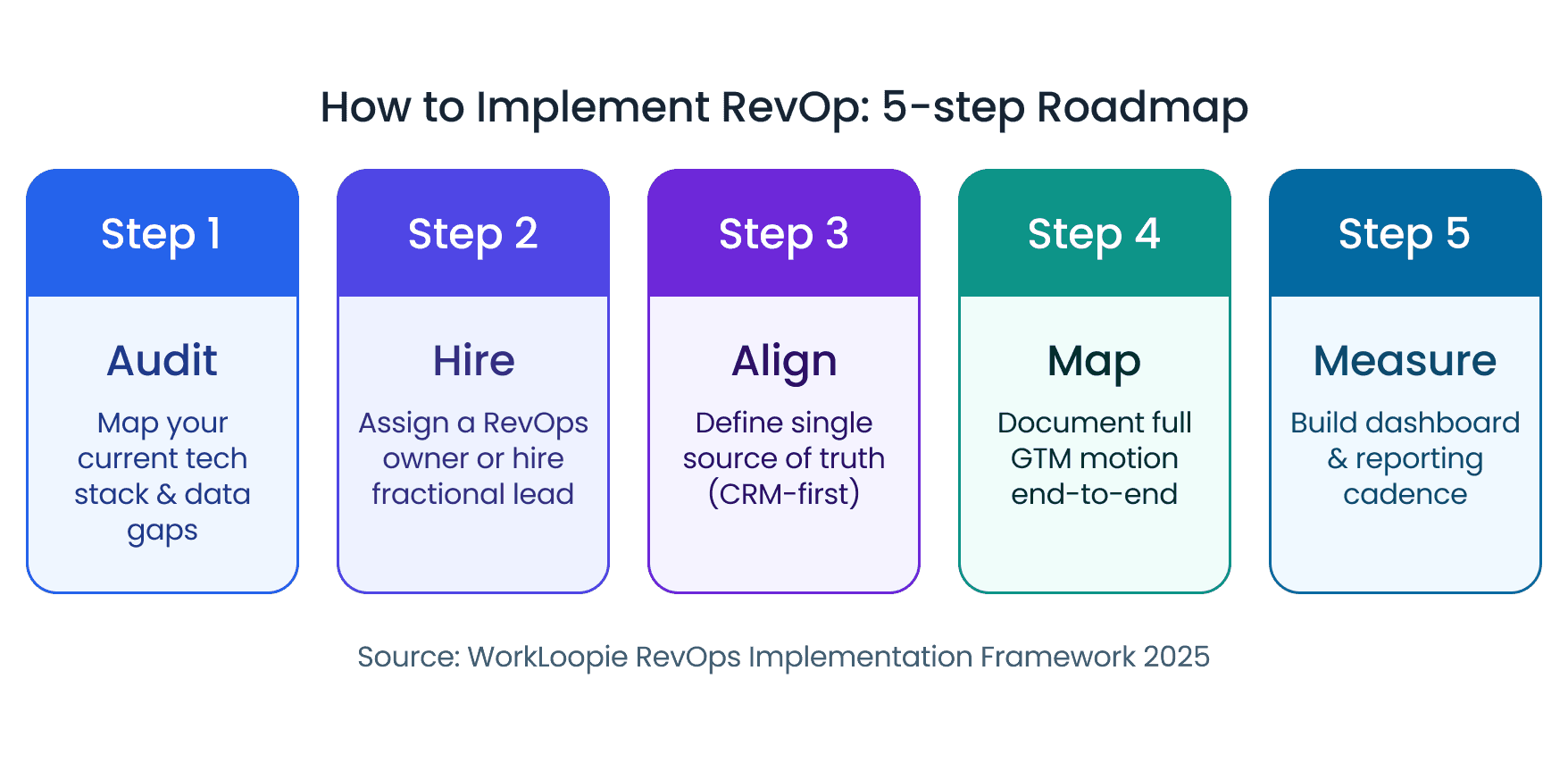
Audit Your Revenue Tech Stack and Data Gaps - Before hiring or restructuring anything, conduct a full inventory of your current tools, integrations, and data quality. Identify orphaned systems, duplicate tools, broken syncs, and gaps in your funnel reporting. This audit is the foundation everything else is built on. Connect with your team, asking them, what is working what does not work?
Identify or Hire a RevOps Owner - Decide whether you need a full-time hire, a fractional RevOps leader, or whether a current team member can take on the function. At Series A, a strong Sales Ops or Marketing Ops professional who understands the full funnel can often step into this role with the right mandate.
Define Your Single Source of Truth - Agree on your CRM as the authoritative system. Define your data model — what fields are required, what a 'clean' contact record looks like, which stage definitions mean what. Document these definitions and get sign-off from Sales, Marketing, and CS leadership.
Map Your Full GTM Motion - Document every stage of the customer journey from first marketing touch to renewal and expansion. Identify every handoff, every SLA, and every potential leak point. This becomes your RevOps operating model.
Build Your RevOps Dashboard and Cadence - Stand up a weekly RevOps review with leadership. Build dashboards that show pipeline health, conversion rates by stage, forecast vs. actuals, and leading indicators by segment. Make the data unavoidable — and make it consistent.
RevOps Tech Stack: Tools That Power Revenue Operations
RevOps doesn't require a specific set of tools — but it does require that whatever tools you use are integrated, bidirectional, and governed. Here's how the typical RevOps stack is organized by category:
Category | RevOps Role |
|---|---|
CRM | Single source of truth for all customer and pipeline data |
Marketing Automation | Lead capture, nurture, scoring, and MQL handoff |
Customer Success | Health scoring, onboarding tracking, renewal alerts |
Revenue Intelligence | Forecast accuracy, deal coaching, conversation analytics |
BI & Reporting | Cross-team dashboards and executive reporting |
Data Enrichment | Contact and account data quality and intent signals |
RevOps KPIs: What Metrics Should You Track?
RevOps owns the measurement layer across the entire revenue organization. Here are the core metrics every RevOps team should monitor, organized by funnel stage:
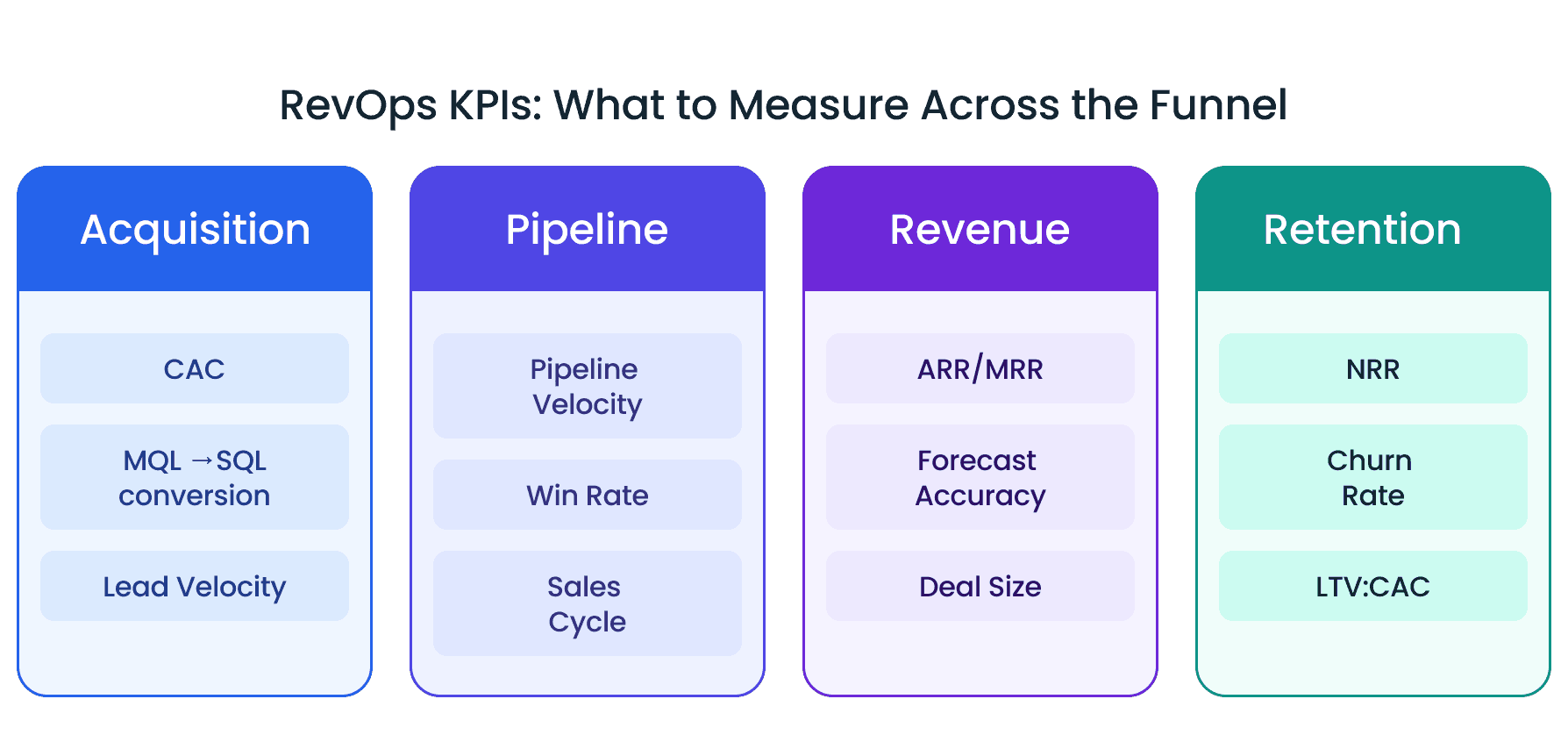
Acquisition Metrics
Customer Acquisition Cost (CAC) — total cost to acquire one new customer
MQL to SQL Conversion Rate — percentage of marketing leads that become sales-qualified
Lead Velocity Rate (LVR) — month-over-month growth in qualified leads
Pipeline Metrics
Pipeline Velocity — how fast deals move through stages (Volume x Win Rate x Deal Size / Sales Cycle Length)
Win Rate — percentage of opportunities that close as won
Average Sales Cycle Length — days from opportunity creation to close
Revenue Metrics
ARR / MRR — Annual / Monthly Recurring Revenue, the primary growth metric
Forecast Accuracy — actual revenue vs. forecast at the start of the period
Average Contract Value (ACV) — average deal size
Retention Metrics
Net Revenue Retention (NRR) — revenue retained and expanded from existing customers (target: 110%+)
Gross Churn Rate — percentage of ARR lost from cancellations
LTV:CAC Ratio — lifetime value of a customer vs. what it cost to acquire them (target: 3:1+)
Is RevOps Right for Your Business?
Revenue Operations is not a trend. It's a structural response to the reality that modern B2B revenue is complex, recurring, and deeply cross-functional. Companies that align their Sales, Marketing, and Customer Success teams around shared data, shared processes, and shared technology consistently outperform those that don't.
If any of the following describe your organization, you're ready to invest in RevOps:
Your sales and marketing teams disagree on what a qualified lead looks like
Your revenue forecast is consistently off by 20% or more
Your CS team finds out about a renewal risk from the customer, not from your CRM
You have three or more separate tools doing overlapping jobs
Leadership can't get a single, trusted pipeline report without manual assembly
Frequently Asked Questions About RevOps
What is RevOps in simple terms?
When should a company hire a Head of RevOps?
Is RevOps the same as Sales Operations?
What is the difference between RevOps and a CRO?
Does RevOps work for companies outside SaaS?
What tools does a RevOps team use?